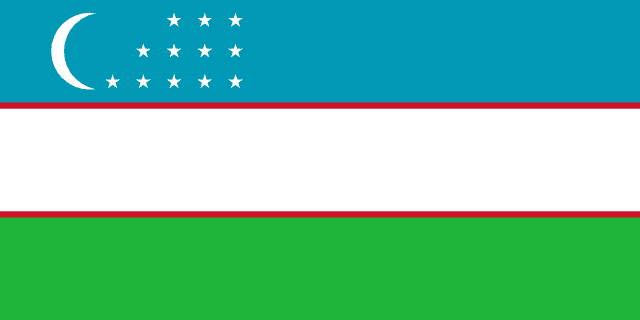
flag — Uzbekistan
Nation by Nation
Uzbekistan
History
History
The land between the Amu Darya and Syr Darya rivers, known to the Greeks as Transoxiana, has been settled for thousands of years. Its oasis cities of Samarkand, Bukhara, and Khiva grew rich as way stations on the routes between China, Persia, India, and the Mediterranean. The ancient kingdoms of Sogdiana and Khwarazm were absorbed into the Persian Empire of Cyrus and Darius in the sixth century BC. Alexander the Great fought his hardest campaigns here between 329 and 327 BC, storming the Sogdian Rock and marrying Roxana, the daughter of a local lord, in an effort to secure the region. After his death it passed to the Greek kings of Bactria, then to the Kushans, under whom Buddhism spread along the trade routes.
From the second century BC the Silk Road made the Sogdian merchants of Samarkand and Bukhara the great middlemen of Eurasia. Their language became the lingua franca of the caravan trade, and their colonies reached as far as China. Zoroastrianism, Buddhism, Manichaeism, and Nestorian Christianity all found followers in the oasis towns before the arrival of Islam.
Arab armies under Qutayba ibn Muslim conquered Bukhara and Samarkand between 705 and 715, and Islam gradually became the faith of the settled population. In the ninth and tenth centuries the Samanid dynasty, ruling from Bukhara, presided over one of the most brilliant periods in the history of Central Asia. Persian literature was reborn at its court, and the region produced scholars whose work shaped the medieval world: al-Khwarizmi, the mathematician from Khwarazm whose name gave us the word "algorithm"; al-Bukhari, compiler of the most trusted collection of the sayings of the Prophet; al-Biruni, the polymath of Khwarazm; and Ibn Sina, known in Europe as Avicenna, born near Bukhara in 980, whose Canon of Medicine was a standard textbook for six centuries.
Turkic peoples from the steppe gradually took control. The Karakhanids ended Samanid rule in 999, and they were followed by the Seljuks and then the Khwarazmshahs, who by 1200 ruled an empire stretching from the Caspian to India. That empire provoked Genghis Khan. Between 1219 and 1221 the Mongols destroyed Bukhara, Samarkand, and Urgench with a thoroughness that became legend, massacring their populations and wrecking irrigation works that had taken centuries to build.
The region's most famous son was born in 1336 near Kesh, now Shakhrisabz, to a minor Turko-Mongol clan. Timur, known in the West as Tamerlane, made himself master of Transoxiana by 1370 and spent the next 35 years conquering Persia, the Caucasus, northern India, Syria, and Anatolia, defeating the Ottoman sultan at Ankara in 1402 and dying in 1405 on his way to invade China. His campaigns were ferocious, but he poured the plunder of Asia into Samarkand, bringing artisans from every conquered land to build the mosques, mausoleums, and gardens that made the city a wonder of the age.
His successors were builders and scholars rather than conquerors. His grandson Ulugh Beg ruled Samarkand for forty years, erected the great madrasa on the Registan, and built an observatory whose star catalogue was the most accurate produced anywhere before the telescope. The Timurid courts of Samarkand and Herat fostered miniature painting, poetry, and architecture that influenced the Persian, Ottoman, and Mughal worlds. In 1526 a Timurid prince from the Fergana Valley, Babur, driven out of his homeland, conquered northern India and founded the Mughal Empire.
Babur's enemies were the Uzbeks, a confederation of Turkic nomads from the north who under Muhammad Shaybani Khan seized Samarkand and Bukhara in the first years of the sixteenth century. They gave the country its name and its ruling dynasties for the next 400 years. Transoxiana split into three rival states: the Khanate, later Emirate, of Bukhara; the Khanate of Khiva in the Khwarazm oasis; and from the early eighteenth century the Khanate of Kokand in the Fergana Valley. The opening of sea routes between Europe and Asia drained the overland trade that had sustained the cities, and the khanates became isolated, conservative, and poor, known to the outside world chiefly for their slave markets and the occasional European traveler who did not return.
Russia, expanding across the Kazakh steppe, reached the khanates in the 1860s. General Chernyayev took Tashkent in 1865, Samarkand fell in 1868, and the Emir of Bukhara accepted the status of a Russian protectorate the same year. Khiva followed in 1873, and Kokand, after a revolt, was annexed outright in 1876. The conquered lands were organized as the Governorate-General of Turkestan with its capital at Tashkent. The emirs of Bukhara and khans of Khiva kept their thrones under Russian supervision. Railways reached Samarkand in 1888 and Tashkent in 1906, and the tsarist administration pushed the planting of American cotton to supply Russian mills, beginning the dependence on a single crop that would define the region's economy for a century. Russian settlers built European new towns beside the old cities. In 1916 a decree conscripting Central Asians for labor behind the front lines provoked a widespread uprising that was crushed with heavy loss of life.
The Russian Revolution reached Tashkent in 1917. Bolshevik rule was contested for years by the Basmachi, Muslim guerrillas in the Fergana Valley and the countryside, and the last emir of Bukhara was driven out by the Red Army in 1920. In 1924 Moscow redrew the map of Central Asia along national lines and created the Uzbek Soviet Socialist Republic, with its capital first at Samarkand and from 1930 at Tashkent. The decades that followed brought collectivization of the land, the closing of mosques and madrasas, campaigns to unveil women, two changes of alphabet from Arabic to Latin to Cyrillic, and the Stalinist purges, which destroyed the republic's first generation of communist leaders.
The Second World War transformed Tashkent into an industrial city as factories and more than a million evacuees were moved east beyond the reach of the German armies. An earthquake leveled much of the old city in 1966, and it was rebuilt in Soviet style with help from across the USSR. Under Sharaf Rashidov, who led the republic from 1959 to 1983, Uzbekistan became the Soviet Union's cotton plantation. The diversion of the Amu Darya and Syr Darya into the cotton fields shrank the Aral Sea to a fraction of its size, one of the worst environmental disasters of the twentieth century, while the falsification of harvest figures in the "cotton scandal" of the 1980s led to thousands of arrests after Rashidov's death. Islam Karimov became first secretary of the Uzbek Communist Party in 1989.
Uzbekistan declared independence on August 31, 1991, after the failed coup in Moscow, and Karimov was elected president that December. He ruled for the next quarter century with little tolerance for opposition, banning rival parties, imprisoning Islamic activists, and extending his term through referendums and elections that outside observers did not consider free. The government's suppression of a protest in Andijan in May 2005, in which hundreds of civilians were reported killed, brought Western sanctions and drew Uzbekistan closer to Russia and China for a time. The economy remained state-dominated and the cotton harvest relied on forced labor, including that of children.
Karimov died in September 2016 and was succeeded by his longtime prime minister, Shavkat Mirziyoyev, who surprised many by loosening the system. He freed political prisoners, made the currency convertible, abolished exit visas, opened the borders with neighboring states after years of hostility, courted foreign investment, and ended the systematic use of forced labor in the cotton fields, a change confirmed by the International Labour Organization in 2022. Political power nonetheless remains firmly concentrated in the presidency; a 2023 constitutional referendum reset Mirziyoyev's term limits and lengthened the presidential term to seven years, and he was re-elected that summer. With a population now approaching 37 million, the largest in Central Asia, and the Silk Road cities of Samarkand, Bukhara, and Khiva drawing growing numbers of visitors, Uzbekistan has again become the center of its region.